
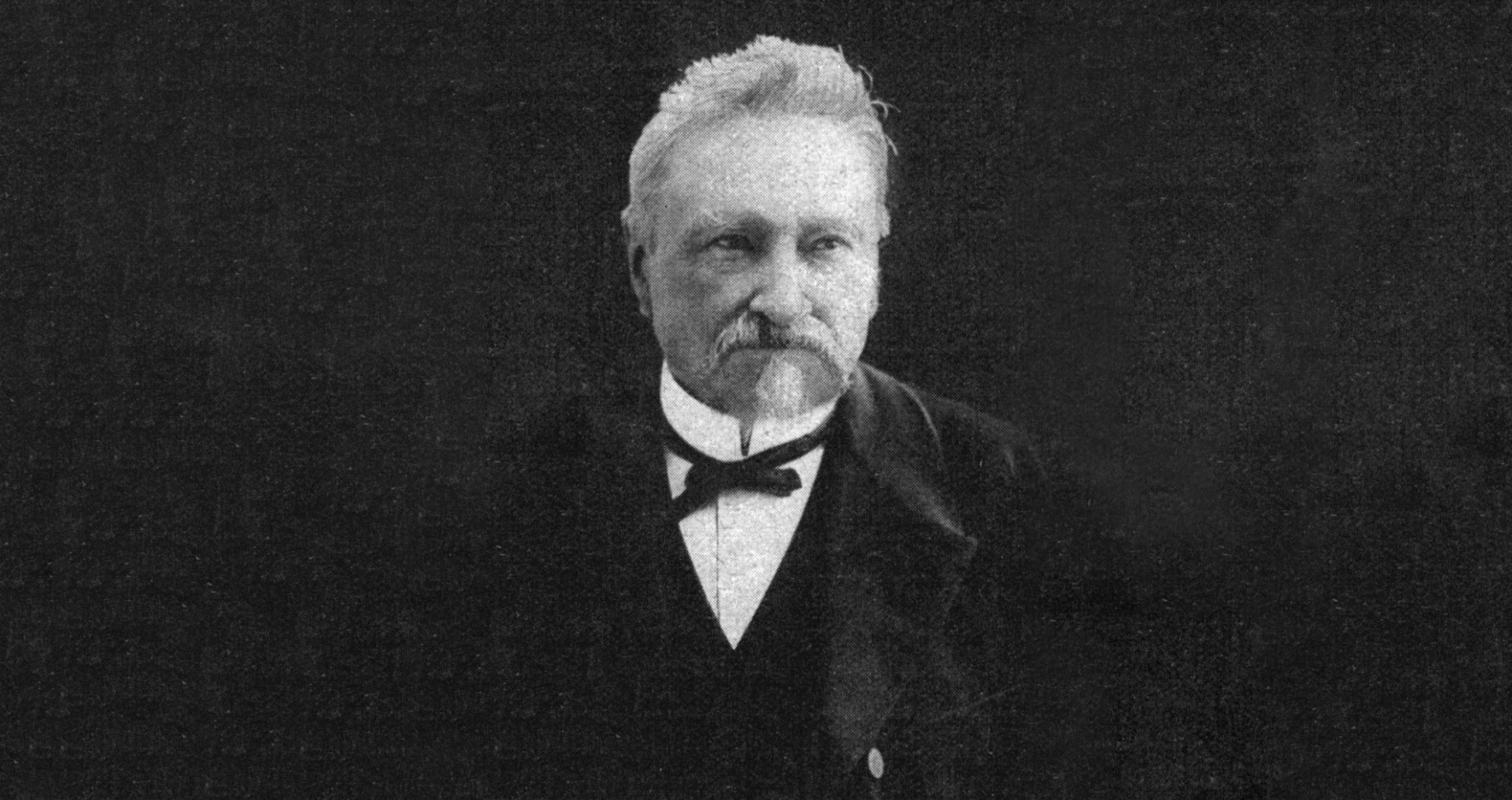
Gustave de Molinari (1819–1912) is the most consequential libertarian thinker most people have never heard of. In February 1849 — a century before Rothbard, thirty-five years before Spencer’s The Man Versus the State, in the same year Thoreau published Civil Disobedience — a thirty-year-old Belgian economist published a fourteen-page article in the Journal des Économistes that did something no one had ever done in the history of political philosophy. He turned the laissez-faire principle against the one institution that all of his fellow liberals — Bastiat, Smith, Say, even the most radical of them — had insisted must remain a state monopoly. He turned it against security itself. He argued that the production of police, courts, and defence should be opened to free competition like every other industry, and that the state’s monopoly on these services was not the foundation of civilisation but the source of war, exploitation, and most of the evils his contemporaries blamed on the market. Murray Rothbard called the article “the first presentation anywhere in human history of what is now called anarcho-capitalism.” Hans-Hermann Hoppe called it “probably the single most important contribution to the modern theory of anarcho-capitalism.” It is, quite simply, the founding document of an entire intellectual tradition. And the man who wrote it lived another sixty-two years, became the editor of France’s most influential economic journal, watched his colleagues abandon laissez-faire one by one, and died in 1912 — two and a half years before the assassination of Franz Ferdinand — still arguing that a society organised on the basis of voluntary exchange would have prevented the catastrophe everyone could see coming.
He was right. They didn’t listen. They never have.
The Walloon
Gustave de Molinari was born on 3 March 1819 in Liège, in the Walloon region of what was then the United Kingdom of the Netherlands and would, eleven years later, become the Kingdom of Belgium. His father, the Baron de Molinari, had served as a medical officer in Napoleon’s army before settling in Liège to practise medicine. The household was bourgeois, intellectual, and sympathetic to liberal politics. Little is recorded of his childhood beyond an early and unwavering passion for literature.
Liège in the 1820s and 1830s was a city in transition — caught between French cultural inheritance, Dutch political administration, and the industrial revolution that was beginning to transform the Wallonian coalfields. The Belgian Revolution of 1830 broke out when Molinari was eleven years old, and the new constitutional monarchy that emerged from it was, by the standards of nineteenth-century Europe, remarkably liberal. Belgium became the first nation on the continent to industrialise, and its constitution enshrined freedoms of religion, press, association, and education that France and Germany would not match for generations. Molinari grew up watching, in real time, what a relatively free society could produce — and what its limits were.
In 1840, at the age of twenty-one, he left for Paris.
Paris and the Carpenters’ Trial
The Paris Molinari arrived in was the capital of European political economy. The Société d’Économie Politique met regularly to debate the doctrines of Smith, Say, and Ricardo. The Journal des Économistes — founded in 1841 — became the flagship periodical of laissez-faire liberalism in continental Europe. The Free Trade movement was gathering force in Britain under Cobden and Bright, and its French equivalents were organising for the abolition of tariffs, internal taxes on grain, and the licensing system that throttled French commerce.
Molinari arrived as a young journalist with no fortune and no connections, and he made his way the way ambitious young men have always made their way in Paris: by writing. He found work at Le Courrier français. And in 1843, he was given an assignment that would mark his entire intellectual trajectory.
Several leaders of the Parisian carpenters’ union were on trial for organising a strike for higher wages. French law at the time forbade workers’ associations — the loi Le Chapelier of 1791 had abolished guilds in the name of liberty, but the bourgeois revolutionaries had then extended the prohibition to working-class associations as well, on the grounds that any combination of labourers constituted a threat to “free competition.” It was a perfect inversion of the principle. The state had used the rhetoric of liberty to forbid voluntary association.
Molinari covered the trial. He saw what the law was actually doing. And he drew a conclusion that would distinguish him from nearly every other classical liberal of his generation: the same logic that demanded free markets in goods demanded free markets in everything else — including the right of workers to associate, the right of communities to organise their own affairs, and ultimately the right of consumers to choose their own protectors. Liberty was either universal or it was a swindle.
By 1846 his economic journalism — particularly his open letters advocating free trade — had attracted the attention of the most important French liberal of the age: Frédéric Bastiat. That summer, Molinari joined Bastiat’s Association pour la Liberté des Échanges as associate secretary and editor of its journal, Le Libre-Échange. He had found his circle.
The Circle of Bastiat
The friendship between Bastiat and Molinari is one of the great intellectual partnerships of the nineteenth century, and one that has been almost entirely overlooked. Bastiat was eighteen years older — already famous, already dying of the tuberculosis that would kill him in 1850 — and he became Molinari’s mentor, ally, and eventually his designated heir.
The two men were temperamentally different. Bastiat was a southern Frenchman with a gift for the elegant essay, the devastating parable, and the witty rejoinder. His That Which Is Seen and That Which Is Not Seen, his Petition of the Candlemakers, his The Law — these are the works of a stylist who understood that economics is, at root, a moral science, and who could make ordinary readers laugh at the protectionist follies of their own governments. Molinari was Belgian, more systematic, less lyrical, more willing to follow an argument to its uncomfortable conclusion. Bastiat would write a perfect aphorism. Molinari would write a treatise.
Together they fought the protectionist establishment of the July Monarchy — the system of tariffs, subsidies, and licensed monopolies that Bastiat called “legalised plunder” — and they were largely defeated. The 1848 Revolution swept away the July Monarchy but did not bring laissez-faire. It brought socialism. The provisional government established the National Workshops, declared the right to work, and fell — within months — into bloody street fighting between the Parisian working class and the army of the new bourgeois republic. By the end of June 1848, four thousand Parisians were dead and Louis-Napoléon Bonaparte was on his way to power.
It was in this atmosphere — with socialism on the march, the laissez-faire orthodoxy in retreat, and the very legitimacy of free markets under question — that Molinari sat down to write the most radical thing any economist had ever written.
The Production of Security
The article appeared in the Journal des Économistes in February 1849. It was titled “De la production de la sécurité” — “On the Production of Security” — and it ran for fourteen pages. It would have been forgotten entirely had J. Huston McCulloch not translated it and Murray Rothbard not championed it more than a century later. Today it stands at the head of an entire intellectual tradition.
Molinari’s argument was disarmingly simple. The economists, he observed, were unanimous that competition was superior to monopoly in every industry — bread, cloth, transport, books. They had spent the better part of a century demonstrating that monopoly raises prices, lowers quality, retards innovation, and corrupts both producers and consumers. They had won this argument so thoroughly that even the socialists had to dress their schemes in the rhetoric of efficiency and progress. And yet, when it came to the one industry that mattered most — the production of security itself, the protection of life and property without which no other industry can function — every economist Molinari had ever read insisted that this single commodity must be supplied by a coercive monopoly called the state.
Why?
There was no economic argument for the exception. There was only assumption — the unexamined inheritance of Hobbes, the ghost of Leviathan haunting the discipline. The economists had never asked whether the principles of competition might apply to security itself. Molinari asked. And he answered with the rigour of his own school turned upon its own blind spot.
If the production of security were opened to free competition, he argued, the same logic that operates in every other market would operate here. Consumers would choose the protectors who offered the best service at the lowest price. Inefficient or abusive providers would lose customers to better ones. Insurance companies would naturally expand into the provision of protection, because the actuarial logic of insurance is identical to the actuarial logic of security: pool risk, prevent loss, settle claims when prevention fails. The result would be a system in which the providers of protection had every incentive to keep their customers safe and no incentive to expand their territory through war — because war, under competition, simply destroys the customers it is supposedly being waged to protect.
And then came the move that none of his contemporaries dared to make. Molinari turned this analysis around and asked what happens when security is provided by a monopoly — that is, by the state. The answer wrote itself. Monopoly raises prices: hence taxation, levied not by consent but by force. Monopoly lowers quality: hence injustice, brutality, corruption. Monopoly retards innovation: hence the millennia of stagnant legal systems, the unchanging brutality of police, the perpetual incompetence of state courts. Monopoly corrupts the monopolist: hence the universal tendency of governments to become more authoritarian over time. And — most importantly — monopolies fight each other when their territories abut, because expanding the customer base is the only way a monopoly can grow.
“War has been the necessary and inevitable consequence of the establishment of a monopoly on security.”
There it is. In one sentence Molinari had explained the entire history of warfare. War is not an aberration in the system of states. War is what the system of states is. It is the inevitable behaviour of monopolies competing for territorial market share, dressed up in the rhetoric of nationhood and necessity. Every war in human history has been a turf war between protection rackets too large to recognise themselves as protection rackets.
He had asked the forbidden question and answered it without flinching. The state is not the solution to the problem of insecurity. The state is the problem of insecurity. And the laissez-faire principle, applied without exception, points toward a society in which protection is supplied by voluntary contract between insurers and the insured, in which no agency holds territorial monopoly, and in which the violence of states gives way to the cooperation of competitors.
It was 1849. He was thirty years old. And he had just written the founding text of a tradition that would not begin to be understood for another century.
The Soirées
Later that same year, Molinari published a fuller statement of the argument in book form: Les Soirées de la Rue Saint-Lazare — “The Evenings of Rue Saint-Lazare.” It is one of the strangest and most charming works of nineteenth-century political economy. The book consists of twelve fictional dialogues, set in a Parisian salon, between three characters: a Conservative who defends the existing order of throne, altar, and tariff; a Socialist who proposes to abolish private property in favour of collective organisation; and an Economist — Molinari himself, lightly disguised — who patiently demolishes both positions and constructs the case for radical laissez-faire across every domain of social life.
The eleventh evening contains the developed version of the security argument. The Economist explains, against the objections of both his interlocutors, how a society might function with competing private agencies providing protection, courts, and adjudication. The Conservative is horrified. The Socialist is mocking. The Economist proceeds, calmly and thoroughly, to dismantle every objection — and to show that what they cannot imagine is precisely what they already half-experience whenever they buy insurance, hire a lawyer, or settle a private dispute without recourse to the state.
The Soirées are not just an economic argument. They are a literary performance — Plato’s dialogues with the topics changed, Voltaire’s wit applied to the question of legitimacy. Molinari is doing something that very few economists have ever attempted. He is showing what a stateless society would feel like — what its conversations would sound like, what its institutions would look like, what its moral atmosphere would be. He is not merely arguing for liberty. He is imagining it.
The book sold poorly. The Soirées have never been fully translated into English. They sit, like so much of the French liberal tradition, neglected on the shelf — waiting for readers who can recognise what they contain.
Bastiat’s Deathbed
In December 1850, in a hotel room in Rome, Frédéric Bastiat lay dying. The tuberculosis that had been hollowing him out for years had finally won.
According to the account that has come down through the French liberal tradition, Bastiat — emaciated, barely able to speak — declared his young friend Molinari his spiritual heir. The torch of laissez-faire, which Bastiat had carried for two decades against the protectionists, the socialists, the Bonapartists, and the moralists who saw in commerce only greed, was passed to a thirty-one-year-old Belgian who had just published the most radical argument any economist had ever made.
Bastiat died on Christmas Eve 1850. Within a year, Louis-Napoléon Bonaparte had overthrown the Republic in his coup of 2 December 1851 and declared himself Emperor. The new regime had no patience for laissez-faire ultras who argued that the state itself was the source of war and exploitation. Molinari was identified, correctly, as a dangerous radical. Within months he was on a train back to Belgium.
Brussels Years
The 1850s were a period of internal exile. Molinari took up a professorship at the Musée royale de l’industrie belge in Brussels and a second post at the Institut supérieur du commerce in Antwerp. He published the Cours d’économie politique — a systematic treatise on economic theory, his bid for academic respectability — and contributed extensive articles to the Dictionnaire de l’économie politique, the great reference work of French laissez-faire scholarship. He founded a newspaper, L’Économiste, in 1855. He continued his attacks on protectionism, slavery, and the colonial system.
But the radical edge of 1849 had been blunted, at least in print. The political climate of the Second Empire — and the conservative Belgium of King Leopold I — did not reward the publication of arguments for the abolition of the state. Molinari’s writing in this period is more academic, more careful, more concerned with technical questions of price theory and trade policy. The man who had imagined a society of competing protectors was now teaching the principles of supply and demand to commerce students in Antwerp.
It is one of the recurring tragedies of the libertarian tradition that its most radical voices are forced, by circumstance, to spend their middle years sounding less radical than they are. Spooner did legal work to pay the bills. Tucker ran a journal that constantly teetered on bankruptcy. Molinari taught business administration in Antwerp. The state has many ways of suppressing dissent that do not require a prison cell. Sometimes it is enough simply to make the dissenter spend his most productive decades earning a living.
The Long Editorship
Molinari returned to Paris in the 1860s as the Second Empire began to liberalise. He joined the staff of the Journal des Débats — the most prestigious French newspaper of the period — and served as its editor from 1871 to 1876. Then, in 1881, he took up the post that would define the rest of his life: editor-in-chief of the Journal des Économistes, the flagship publication of French laissez-faire liberalism.
He held the post for twenty-eight years.
For nearly three decades — from 1881 to 1909 — every issue of France’s most important economic journal passed through Molinari’s hands. He commissioned articles, fought editorial battles, mentored younger writers, and published his own continuing stream of books and essays. He used the platform to attack every form of state expansion he saw rising around him: the new protectionism of the 1880s, the imperialism of the scramble for Africa, the militarism of the Franco-Russian alliance, the socialism of Jaurès and Guesde, the welfarism that was beginning to transform Bismarck’s Germany and would soon transform every European state.
The major works of his maturity belong to this period. L’Évolution économique du dix-neuvième siècle (1880) and L’Évolution politique et la révolution (1884) are sweeping historical syntheses, arguing that all of human history can be read as a slow movement away from “exploitative” social organisations — slavery, feudalism, mercantilism — toward “voluntary” ones based on free exchange. Grandeur et décadence de la guerre (1898) is a sustained polemic against militarism, drawing on his 1849 insight that war is the natural product of state monopoly on security. Esquisse de l’organisation politique et économique de la Société future (1899) — published in English as The Society of Tomorrow — is his most ambitious late work, a vision of a future world organised on the basis of voluntary cooperation, free trade, and the gradual dissolution of national sovereignty into something more like global federation.
The Society of Tomorrow contains a famous concession. By 1899, in his eightieth year, Molinari conceded that his 1849 vision of competing private protection agencies might not be practically achievable in the immediate future. He suggested, instead, that local geographic monopolies — city-states, perhaps, or competing decentralised governments — might be a more realistic intermediate step than the full anarchic competition of the original argument. Some readers have taken this as a retreat from anarcho-capitalism. Others — including Rothbard — have read it as a strategic accommodation to the realities of the moment, with the underlying principle preserved. The truth is probably somewhere in between. He had been arguing for fifty years. He was tired. The world was getting worse, not better. And he wanted to leave behind a vision that someone, somewhere, might actually be able to build.
The Last Voice
The man would not stop writing.
In 1901, at the age of eighty-two, he published Les Problèmes du XXe siècle — a survey of the threats facing the new century, focused on the rising tide of state expansion. In 1908, at eighty-nine, he published Théorie de l’évolution: Économie de l’histoire. And in 1911, at the age of ninety-two, he published his final book — aptly titled Ultima Verba: Mon dernier ouvrage. “Last Words: My Final Work.”
He had been arguing the same case for sixty-two years. Free trade. Voluntary association. Property rights. Peace. Against tariffs, against empire, against war, against socialism, against the slow conversion of every European government into a machine for plunder, redistribution, and mobilisation. He had outlived Bastiat by sixty-one years, Marx by twenty-eight, Spencer by eight. He had watched the laissez-faire generation of 1848 die off one by one. He had seen the rise of the Bismarckian welfare state, the consolidation of European empires, the build-up of the standing armies that would, two and a half years after his death, march into the trenches of the First World War.
He saw all of it coming. He named the mechanism — the state’s monopoly on security generating the war it was supposedly created to prevent. He warned, again and again, that the alliance system, the protectionism, the militarism, and the socialism were converging toward a catastrophe that would make 1848 look like a footnote.
He died on 28 January 1912 in Adinkerque (now De Panne), on the Belgian coast, at the age of ninety-two. Two and a half years later, on 28 June 1914, Archduke Franz Ferdinand was shot in Sarajevo. Within six weeks, the great European war Molinari had spent his life predicting had begun. Within four years, ten million soldiers were dead, the empires of Europe had collapsed, the Russian state had fallen to the Bolsheviks, and the laissez-faire liberalism Molinari had defended for seven decades was finished as a living political tradition.
Fortunately, perhaps, he did not live to see it.
The Insurance Society
The substantive argument of The Production of Security deserves a closer look, because Molinari’s model is far more carefully developed than its critics have understood. He did not propose anarchy in the sense of chaos. He did not propose competing warlords. He proposed what we would now recognise as insurance — an industry that already existed in 1849, that had been functioning for several centuries by then in maritime trade and fire prevention, and that operated on principles directly applicable to the production of security.
An insurance company makes its money by underwriting risk. It accepts premium payments from clients in exchange for a contractual obligation to make them whole if specified bad things happen. It has every incentive to prevent those bad things from happening — because every claim is a cost. It has every incentive to settle claims fairly — because reputation is its primary asset. It has every incentive to operate honestly — because fraud is punishable, customers can leave, and competitors are watching. The insurance industry already demonstrated, in 1849 as it does today, that highly complex risk-management services can be supplied by voluntary contract, in a competitive market, without any state monopoly.
Molinari simply asked: why not security? An insurance company that protected its clients from theft, assault, and fraud — that hired investigators when crimes occurred, that maintained patrols in the neighbourhoods of its policyholders, that contracted with arbitration tribunals to settle disputes — would be doing exactly what the state claims to do, but doing it through voluntary contract rather than coercive monopoly. Multiple such companies would compete for clients. Bad ones would lose business. Good ones would expand. Disputes between policyholders of different companies would be settled by mutually agreed arbitrators, just as international commercial disputes were already being settled by mutually agreed arbitrators in 1849.
This is not a fantasy. This is how vast portions of human society actually function, and have always functioned, beneath and around the state’s claim to monopoly. Commercial law, maritime law, insurance, arbitration, security guards, private investigators, mediation — all of these are already private, voluntary, competitive industries, providing services that the state also claims to provide and almost always provides worse. Molinari asked the obvious question: why not go further? Why not all of it?
The state has never given a satisfactory answer. It has only insisted that the question must not be asked.
Legacy
Molinari’s reputation has had a strange trajectory. In his own lifetime he was a respected if unfashionable figure — the last surviving member of Bastiat’s circle, an editor of distinction, an intellectual presence in the French liberal tradition. After his death he was almost completely forgotten outside specialist circles. The classical liberal tradition itself collapsed in the wake of the First World War, taking Molinari’s reputation with it. The Production of Security was not translated into English until 1977 — a hundred and twenty-eight years after its original publication. The Soirées has never been published in a complete English translation, though partial drafts circulate online.
Then came the rediscovery. Murray Rothbard, working in the 1960s and 1970s on the foundations of anarcho-capitalism, recognised in Molinari the predecessor he had not known he had. Rothbard’s introduction to the 1977 translation made the case bluntly: this was the first systematic statement of the position Rothbard himself was developing, and it had been written more than a century earlier by an obscure Belgian economist whose name was not even in most economics textbooks. The line ran from Molinari directly to Power and Market, For a New Liberty, and The Ethics of Liberty. Rothbard had been building, without knowing it, on foundations Molinari had laid.
The line continued. Hans-Hermann Hoppe took Molinari’s argument as the starting point for his own critique of democracy. David Friedman — coming at the same problem from utilitarian rather than natural-rights premises — independently rediscovered the case for private protection in The Machinery of Freedom. The Molinari Institute, founded by Roderick Long, exists today as a centre of left-libertarian and market-anarchist scholarship, named for the man whose 1849 article launched the tradition. Bruce Benson’s empirical work on the historical functioning of private law and competing courts — in medieval Iceland, in the Anglo-Saxon hundreds, in commercial arbitration today — confirms in detail the picture Molinari sketched in theory.
What Molinari did, in short, was to break the spell. Every classical liberal before him had drawn a circle around “security” and labelled it the one good that markets could not produce. Molinari erased the line. He showed that the principle of voluntary exchange, applied without exception, points toward the dissolution of the state itself — not into chaos but into the same kind of voluntary, contractual, competitive ordering that already exists everywhere markets are allowed to function. The state is not a necessary evil. The state is a category error — an attempt to provide a service through monopoly that can only be properly provided through competition.
He also did something subtler and perhaps more important. He showed that the libertarian principle is not a programme of half-measures. It is not “smaller government” or “lower taxes” or “a return to the Constitution.” It is a complete philosophical position with a complete philosophical conclusion, and that conclusion is that coercive government is incompatible with the principles its own defenders claim to honour. You cannot consistently defend property rights and tax. You cannot consistently defend voluntary exchange and conscript. You cannot consistently defend liberty and impose any “necessary” exception — because the moment you grant the exception, the rest of the structure collapses. Molinari understood this in 1849. Most of his fellow classical liberals never understood it at all.
He sat in his editorial office in Paris through the long Belle Époque, watching a continent that had grown rich on free trade abandon free trade for empire, watching nations that had grown peaceful through commerce abandon commerce for armaments, watching governments that had been small enough to constrain become large enough to consume their populations. He kept writing. He kept publishing. He kept making the argument no one wanted to hear. And he died, two and a half years before the catastrophe, with his last book in print and his case unrefuted.
The state did not refute Molinari. The state simply ignored him. And then, exactly as he had warned, the state went to war.
Key Works
- De la production de la sécurité (“The Production of Security”) (1849) — The founding text of anarcho-capitalism. Published in the Journal des Économistes, February 1849. Argues that the principles of free competition apply to security as to every other industry, and that the state’s monopoly on protection is the source of war, taxation, and tyranny.
- Les Soirées de la Rue Saint-Lazare (1849) — Twelve dialogues between a Conservative, a Socialist, and an Economist, developing the laissez-faire argument across every domain of social life. The eleventh evening contains the fullest contemporaneous statement of the security argument.
- Cours d’économie politique (1855; 2nd ed. 1863) — Molinari’s systematic treatise on economic theory, written during his Belgian exile.
- L’Évolution économique du dix-neuvième siècle: Théorie du progrès (1880) — Historical synthesis arguing that the rise of voluntary, market-based “industrial” society represents the central trajectory of human progress.
- L’Évolution politique et la révolution (1884) — Companion volume tracing the political evolution of European states, with particular attention to the failures of the French Revolution.
- Grandeur et décadence de la guerre (1898) — Sustained polemic against militarism, applying the 1849 analysis of state monopoly to the rising arms race of the late nineteenth century.
- Esquisse de l’organisation politique et économique de la Société future (“The Society of Tomorrow”) (1899) — Molinari’s vision of a future organised on voluntary cooperation, free trade, and the dissolution of national sovereignty.
- Les Problèmes du XXe siècle (1901) — Survey of the threats facing the new century, focused on protectionism, imperialism, and the rising tide of state expansion.
- Théorie de l’évolution: Économie de l’histoire (1908) — Late synthesis applying evolutionary theory to economic and political history.
- Ultima Verba: Mon dernier ouvrage (“Last Words”) (1911) — Molinari’s final book, published at the age of ninety-two, less than a year before his death.
Notable Quotations
“War has been the necessary and inevitable consequence of the establishment of a monopoly on security.”
— The Production of Security (1849)
“Just as war is the natural consequence of monopoly, peace is the natural consequence of liberty.”
— The Production of Security (1849)
“The true remedy for most evils is none other than liberty, unlimited and complete liberty, liberty in every field of human endeavour.”
— The Production of Security (1849)
“Now in pursuing these principles, one arrives at this rigorous conclusion: that the production of security should, in the interests of the consumers of this intangible commodity, remain subject to the law of free competition. Whence it follows: that no government should have the right to prevent another government from going into competition with it, or require consumers of security to come exclusively to it for this commodity. Either this is logically true, or else the principles on which economic science is based are invalid.”
— The Production of Security (1849)
“What does a tax do? It takes either from the producer or the consumer a more or less sizable portion of the product destined in part to consumption and in part to savings, in order to apply it to less productive or even destructive ends, and more rarely to savings.”
— The Production of Security (1849)
“This monopoly being, by its very nature, extraordinarily profitable, everywhere we see the races invested with the monopoly on security devoting themselves to bitter struggles, in order to add to the extent of their market, the number of their forced consumers, and hence the amount of their gains.”
— The Production of Security (1849)
“There are two ways of considering society. According to some, the development of human associations is not subject to providential, unchangeable laws. Rather, these associations, having originally been organised in a purely artificial manner by primeval legislators, can later be modified or remade by other legislators, in step with the progress of social science.”
— The Production of Security (1849)
“True economists are generally agreed that the government should restrict itself to guaranteeing the security of its citizens. But why should there be an exception relative to security? What special reason is there that the production of security cannot be relegated to free competition?”
— The Production of Security (1849)
Further Reading
- The Production of Security — Full text of the McCulloch translation at the Mises Institute, with Murray Rothbard’s 1977 preface.
- On the Production of Security (1849) — Alternative full-text translation at the Coppet Institute, with annotations.
- The Society of Tomorrow — Full text at the Library of Economics and Liberty, with annotations and biographical material by David M. Hart.
- “Life and Works of Gustave de Molinari” — David M. Hart’s comprehensive biographical essay, the definitive English-language overview of Molinari’s career and writings.
- The Molinari Institute — Roderick Long’s centre for market anarchist scholarship, named for Molinari and identifying him as the “originator of the theory of Market Anarchism.”
- Gustave de Molinari — Mises Institute author profile, with curated essays and works.
- Murray N. Rothbard, “Preface” to Gustave de Molinari, The Production of Security, trans. J. Huston McCulloch (New York: Center for Libertarian Studies, 1977) — The 1977 introduction that recovered Molinari for the modern libertarian tradition.
- Hans-Hermann Hoppe, The Myth of National Defense: Essays on the Theory and History of Security Production (Mises Institute, 2003) — Edited collection extending Molinari’s argument with contemporary scholarship.
- David D. Friedman, The Machinery of Freedom: Guide to a Radical Capitalism (1973) — Independent twentieth-century rediscovery of the case for private protection, with substantial discussion of the Molinari position.
- Bruce Benson, The Enterprise of Law: Justice Without the State (1990) — Empirical demonstration of how legal and security services have functioned historically through private and customary arrangements, providing concrete vindication of Molinari’s theoretical argument.
- Ralph Raico, Classical Liberalism and the Austrian School (Mises Institute, 2012) — Includes substantial scholarly treatment of Molinari and the French Liberal School.



Leave A Comment