
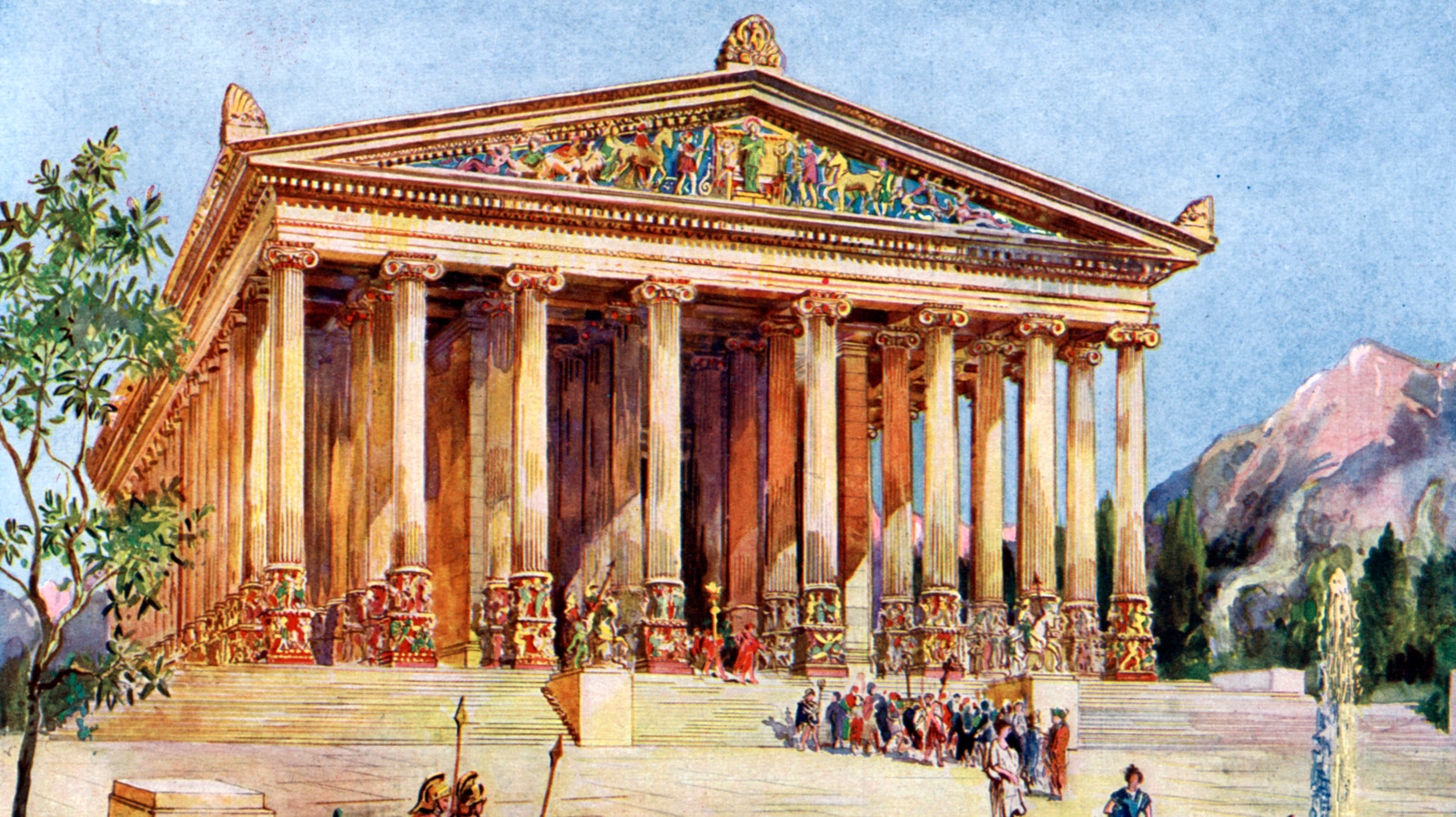
A Modern Allegory
The Temple
“Ye men of Ephesus, what man is there that knoweth not how that the city of the Ephesians is a worshipper of the great goddess Diana [Artemis], and of the image which fell down from Jupiter?” [1]
The town clerk’s rhetorical question reveals the trick. The worship of Diana [Artemis] was so embedded in Ephesian life that questioning it was treated as absurd — not because the evidence was strong, but because the assumption was universal. NASA operates in the same space. What man is there that knoweth not that America went to the Moon? The proposition is placed beyond scrutiny, not by proof, but by cultural saturation. The image which fell down from Jupiter — an origin story nobody witnessed but everybody accepted — mirrors a founding mythology built on footage and telemetry that NASA itself admits it lost or taped over. The image didn’t fall from Jupiter. It was made with hands. And so was the narrative.
Stephen, before they killed him for it, said the quiet part out loud: “Howbeit the most High dwelleth not in temples made with hands.” [2] The Moon landing doesn’t dwell in reality. It dwells in a temple made with hands — constructed from edited footage, staged photography, disappearing data, and a cultural enforcement apparatus that punishes anyone who looks too closely at the masonry.
The Artemis programme is the latest temple. Named after the goddess herself, it doesn’t need to reach the Moon — it never could and never will. It needs to exist — visibly, expensively, and beyond question.
The Silversmiths
“For a certain man named Demetrius, a silversmith, which made silver shrines for Diana [Artemis], brought no small gain unto the craftsmen.” [1]
Lockheed Martin, Boeing, Northrop Grumman, Raytheon — these are the Demetriuses. They don’t make silver shrines; they make rockets that will never carry anyone to the Moon, billed at $4 billion per launch, structured on cost-plus contracts where overruns are rewarded, and hardware dumped into the ocean where no one can examine it. The craft isn’t spaceflight — there is no spaceflight. The craft is the contracting. Every delay, every redesign, every budget overrun is another shrine sold, bringing “no small gain unto the craftsmen.”
“Whom he called together with the workmen of like occupation, and said, Sirs, ye know that by this craft we have our wealth.” [1]
The supply chain stretches across nearly every US congressional district by design. This isn’t inefficiency — it’s architecture. Demetrius didn’t rally silversmiths with theology. He rallied them with economics. Ye know that by this craft we have our wealth. The defence of Artemis in Congressional hearings sounds identical. Nobody stands at the podium and says, “This rocket works.” They can’t — because it doesn’t. They say, “This programme supports forty thousand jobs across sixteen states.” The appeal is never to the goddess. It’s to the payroll.
The Threat
“Moreover ye see and hear, that not alone at Ephesus, but almost throughout all Asia, this Paul hath persuaded and turned away much people, saying that they be no gods, which are made with hands.” [1]
Now imagine someone stands up and says what Paul said — that gods made with hands are no gods at all. Anyone who points out that the Moon landings were staged, who identifies the anomalies in the footage, who asks why the telemetry was conveniently lost, who notes that 1969 slide-rule technology could not have achieved what billions in modern supercomputing still cannot replicate — that person is Paul in Ephesus. They are saying the shrines are made with hands. They are saying the goddess is not real.
And like Paul, they are not met with evidence. They are met with the machinery of suppression.
Demetrius didn’t say Paul was wrong. He said Paul was dangerous. The concern was never theological accuracy. It was market share. Paul had “turned away much people” — the real crime was persuasion, not heresy. Today, the offence isn’t being incorrect about NASA. The offence is being persuasive about it. A man muttering to himself in a pub about the Moon landings is tolerated. A man with a platform, an audience, and receipts is a threat to the silversmiths.
“So that not only this our craft is in danger to be set at nought; but also that the temple of the great goddess Diana [Artemis] should be despised, and her magnificence should be destroyed, whom all Asia and the world worshippeth.” [1]
Notice the structure of Demetrius’s argument. He leads with the economic threat — “this our craft is in danger to be set at nought” — and then bolts the religious justification on afterward. The temple and her magnificence are the wrapping paper. The package is revenue. When NASA defenders respond to sceptics, the structure is identical: they lead with the emotional and cultural appeal — “you’re dishonouring the astronauts, you’re denying science” — to protect what’s actually at stake, which is a procurement pipeline worth hundreds of billions, “whom all the world worshippeth.” The magnificence is the fraud. And the fraud is magnificent.
The Mob
“And when they heard these sayings, they were full of wrath, and cried out, saying, Great is Diana [Artemis] of the Ephesians.” [1]
The response to Paul was not evidence. It was not a calm demonstration of Diana’s [Artemis’s] divinity. It was wrath and a slogan. The modern equivalent is instant and total: “Conspiracy theorist.” “Science denier.” “Tinfoil hat.” The chanting serves the same function — not to refute, but to drown out. You do not debate a man who can prove your goddess is made of silver. You shout over him.
“But when they knew that he was a Jew, all with one voice about the space of two hours cried out, Great is Diana [Artemis] of the Ephesians.” [1]
Two hours of one phrase. No debate. No engagement with Alexander’s defence. The moment they identified him as an outsider — “when they knew that he was a Jew” — the mob shouted him down. The parallel is precise. The moment someone is identified as a “conspiracy theorist,” no argument they make will be heard. The label functions exactly as the ethnic identification did in Ephesus: it marks the speaker as outside the temple, and therefore unworthy of a hearing. The crowd doesn’t need to answer the argument. They just need to chant louder.
“Some therefore cried one thing, and some another: for the assembly was confused; and the more part knew not wherefore they were come together.” [1]
Most people who shout down NASA sceptics haven’t examined a frame of footage themselves. They’ve never looked at the crosshair anomalies, the lighting inconsistencies, the waving flag, the Van Allen belts. They’re in the theatre because everyone else is. The mob is self-sustaining. It doesn’t require informed participants — just loud ones.
The Violence
The believers in the shrine didn’t just chant. They attacked.
“And the whole city was filled with confusion: and having caught Gaius and Aristarchus, men of Macedonia, Paul’s companions in travel, they rushed with one accord into the theatre.” [1]
They seized Paul’s companions — physically grabbed them and dragged them into the arena. When the mob couldn’t find the man making the argument, they went after the people standing near him. This is the modern pattern exactly. When a prominent figure questions the NASA narrative online, the mob doesn’t just come for them. It comes for their associates, their platform hosts, their sponsors, their families. The silversmiths don’t need to catch Paul. They just need to make an example of Gaius and Aristarchus — and everyone else will think twice before standing next to him.
“And when Paul would have entered in unto the people, the disciples suffered him not. And certain of the chief of Asia, which were his friends, sent unto him, desiring him that he would not adventure himself into the theatre.” [1]
Paul’s own allies told him not to show his face. The threat was so credible that even sympathetic officials — people who privately agreed with him — warned him to stay hidden. This is the chilling effect. How many engineers, physicists, and insiders know the pantomime for what it is but will never speak because they’ve watched what happens to those who do? The friends don’t say “you’re wrong.” They say “don’t go in there.” The theatre is not a place of debate. It’s a place of destruction.
“And they drew Alexander out of the multitude, the Jews putting him forward. And Alexander beckoned with the hand, and would have made his defence unto the people. But when they knew that he was a Jew, all with one voice about the space of two hours cried out, Great is Diana [Artemis] of the Ephesians.” [1]
Alexander tried to speak. He raised his hand. He attempted a defence. And he was obliterated — not by counter-argument, but by two hours of unified screaming. His identity was enough to disqualify him. Online, this war plays out daily. Someone raises a hand in a comment section, on a podcast, in a video — “I’d like to make a defence” — and before the first sentence is finished, the algorithm buries them, the comments swarm, the label is applied, and the chant begins. Great is Artemis. Great is NASA. Trust the science. For two hours. For two days. For however long it takes to silence the speaker.
And it goes further than social silencing. The scripture records what happens when the mob escalates beyond chanting:
“And there came thither certain Jews from Antioch and Iconium, who persuaded the people, and, having stoned Paul, drew him out of the city, supposing he had been dead.” [3]
They stoned Paul and left him for dead. Not a metaphor. Not a social media pile-on. Rocks. In the modern theatre, the rocks are deplatforming, career destruction, financial strangulation, and reputational assassination. Channels deleted. Hosting pulled. Payment processors severed. Advertisers pressured. The man is dragged out of the city and left for dead — professionally, socially, financially — and the silversmiths suppose he is finished.
“But the Jews which believed not, moved with envy, took unto them certain lewd fellows of the baser sort, and gathered a company, and set all the city on an uproar, and assaulted the house of Jason, and sought to bring them out to the people. And when they found them not, they drew Jason and certain brethren unto the rulers of the city, crying, These that have turned the world upside down are come hither also.” [4]
When they couldn’t find Paul, they raided the house of the man hosting him. They dragged Jason before the authorities. And the accusation is the most revealing line in all of scripture for this allegory: “These that have turned the world upside down are come hither also.” That is the charge. Not that the dissenters are wrong. Not that they’ve lied. But that they’ve turned the world upside down. The crime is disruption. The crime is making people question the shrine. The same accusation is levelled today at every prominent NASA sceptic — not “here is why you’re factually incorrect,” but “you are dangerous, you are destabilising, you are turning the world upside down.”
And then there is Stephen — the man who said the unsayable:
“Howbeit the most High dwelleth not in temples made with hands.” [2]
For this, the response was absolute:
“When they heard these things, they were cut to the heart, and they gnashed on him with their teeth… Then they cried out with a loud voice, and stopped their ears, and ran upon him with one accord, And cast him out of the city, and stoned him.” [2]
They stopped their ears. They literally refused to hear. Then they killed the speaker. Stephen didn’t blaspheme their god. He stated a fact — that the divine doesn’t live in man-made structures. And they gnashed their teeth, covered their ears, and murdered him for it. Every person who has been destroyed online for pointing out that NASA’s temple is made with hands — made of green screens, wire harnesses, swimming pools, and CGI — knows this pattern intimately. The mob does not engage. The mob does not listen. The mob stops its ears, gnashes its teeth, and stones the speaker.
The Laundering Mechanism
“Sirs, ye know that by this craft we have our wealth.” [1]
That single line is the entire model. Congress appropriates billions to NASA. NASA awards contracts to the silversmiths. The silversmiths employ workers across key districts. Those workers’ jobs depend on continued funding. The contractors lobby Congress for continued funding. Congress appropriates billions to NASA.
The loop is closed. The money cycles from taxpayer to government to contractor to lobbyist and back to government. The “product” — a rocket, a mission, a moonshot — is the shrine that justifies the cycle. The shrine doesn’t do anything. It was never meant to. No one is going to the Moon. No one ever did. The temple economy doesn’t require a real goddess. It requires belief in the goddess. The shrines are made with hands, and the hands are on the treasury.
Artemis has consumed over $90 billion with a per-launch price that makes it the most expensive prop ever built. But functionality was never the point. The SLS exists because cancelling it would be like smashing Diana’s [Artemis’s] temple — not a theological problem, but an economic one. By this craft we have our wealth.
The Absence of a Clerk
“And when the townclerk had appeased the people, he said… Wherefore if Demetrius, and the craftsmen which are with him, have a matter against any man, the law is open, and there are deputies: let them implead one another.” [1]
In the biblical account, a rational voice finally intervenes. The clerk tells the mob to use proper legal channels — “the law is open.” He offers due process. He disperses the crowd.
“For ye have brought hither these men, which are neither robbers of churches, nor yet blasphemers of your goddess.” [1]
Even the clerk acknowledges that the accused have committed no offence. They haven’t robbed the temple. They haven’t blasphemed the goddess. Their only crime is speech — saying that gods made with hands are no gods at all. The modern parallel is exact. NASA sceptics have broken no law. They’ve stolen nothing. They’ve committed no fraud. Their offence is asking questions the silversmiths cannot afford to have answered.
In the modern allegory, there is no clerk. The institutions that would investigate — Congress, the Inspector General, mainstream media — are all inside the temple. They all profit from the shrine. The craftsmen are the oversight. “The law is open” means nothing when the court is in the temple, the judge is a priest, and the jury are silversmiths.
“For we are in danger to be called in question for this day’s uproar, there being no cause whereby we may give an account of this concourse.” [1]
Even the clerk’s motive was self-preservation — not justice. He feared Rome’s attention. Today, the only thing that could function as Rome — an outside authority powerful enough to audit the temple and expose the empty altar behind the curtain — doesn’t exist. There is no empire above the empire. The fraud audits itself.
The Name
“The temple of the great goddess Diana [Artemis] should be despised, and her magnificence should be destroyed.” [1]
This was Demetrius’s worst nightmare — not that Diana [Artemis] was false; he already knew she was false. Every silversmith knows what he made with his own hands. The nightmare was that the public would see it. That the magnificence — the spectacle, the theatre, the pageantry of launches and spacesuits and mission control — would be recognised for what it is: a production. A pantomime. A shrine built to justify its own construction.
But the war is underway. Every day, more people are walking into the theatre and saying what Paul said, what Stephen died for: these are no gods, which are made with hands. Every day, the mob chants louder, stones harder, and stops its ears more desperately — because the silversmiths know something the crowd doesn’t. They know what they made. They know the altar is empty. And they know that when enough people see it, the chanting won’t be enough.
NASA named this programme Artemis — Diana’s true name. They told you what it was. A shrine. An economy of belief. A facade that doesn’t need to reach the Moon. It just needs you to never stop believing.
Great is Artemis of the Americans.
Notes
A Note on Diana and Artemis
The King James Version (1611), used throughout this essay, renders the Greek Ἄρτεμις (Artemis) as “Diana,” following the convention of its era in substituting the Roman equivalent for the Greek deity. Diana was the Roman goddess of the hunt and the moon; Artemis was her Greek counterpart. The temple at Ephesus, one of the Seven Wonders of the Ancient World, was dedicated to Artemis — not Diana — and the Ephesian silversmiths would have known her by that name. The KJV translators, working in a Latin-influenced tradition, used “Diana” in all five occurrences: Acts 19:24, 19:27, 19:28, 19:34, and 19:35.
Modern English translations restore the original Greek. The following render the name as “Artemis” in all five verses: the English Standard Version (ESV), the New International Version (NIV), the New American Standard Bible (NASB), the New Living Translation (NLT), the Christian Standard Bible (CSB), the Revised Standard Version (RSV), and the New Revised Standard Version (NRSV). The Douay-Rheims Bible (1582/1610), translated from the Latin Vulgate, also uses “Diana,” as does the earlier Wycliffe Bible (1382). Young’s Literal Translation (1862) uses “Artemis.”
Where this essay quotes the KJV text, “[Artemis]” is inserted in brackets after “Diana” to clarify that the same deity is meant — and to make explicit the connection to NASA’s Artemis programme, which bears the original Greek name of the goddess the KJV calls Diana.
Scripture References (King James Version)
[1] Acts 19:23–41
23 And the same time there arose no small stir about that way. 24 For a certain man named Demetrius, a silversmith, which made silver shrines for Diana, brought no small gain unto the craftsmen; 25 Whom he called together with the workmen of like occupation, and said, Sirs, ye know that by this craft we have our wealth. 26 Moreover ye see and hear, that not alone at Ephesus, but almost throughout all Asia, this Paul hath persuaded and turned away much people, saying that they be no gods, which are made with hands: 27 So that not only this our craft is in danger to be set at nought; but also that the temple of the great goddess Diana should be despised, and her magnificence should be destroyed, whom all Asia and the world worshippeth. 28 And when they heard these sayings, they were full of wrath, and cried out, saying, Great is Diana of the Ephesians. 29 And the whole city was filled with confusion: and having caught Gaius and Aristarchus, men of Macedonia, Paul’s companions in travel, they rushed with one accord into the theatre. 30 And when Paul would have entered in unto the people, the disciples suffered him not. 31 And certain of the chief of Asia, which were his friends, sent unto him, desiring him that he would not adventure himself into the theatre. 32 Some therefore cried one thing, and some another: for the assembly was confused; and the more part knew not wherefore they were come together. 33 And they drew Alexander out of the multitude, the Jews putting him forward. And Alexander beckoned with the hand, and would have made his defence unto the people. 34 But when they knew that he was a Jew, all with one voice about the space of two hours cried out, Great is Diana of the Ephesians. 35 And when the townclerk had appeased the people, he said, Ye men of Ephesus, what man is there that knoweth not how that the city of the Ephesians is a worshipper of the great goddess Diana, and of the image which fell down from Jupiter? 36 Seeing then that these things cannot be spoken against, ye ought to be quiet, and to do nothing rashly. 37 For ye have brought hither these men, which are neither robbers of churches, nor yet blasphemers of your goddess. 38 Wherefore if Demetrius, and the craftsmen which are with him, have a matter against any man, the law is open, and there are deputies: let them implead one another. 39 But if ye enquire any thing concerning other matters, it shall be determined in a lawful assembly. 40 For we are in danger to be called in question for this day’s uproar, there being no cause whereby we may give an account of this concourse. 41 And when he had thus spoken, he dismissed the assembly.
[2] Acts 7:48–58
48 Howbeit the most High dwelleth not in temples made with hands; as saith the prophet, 49 Heaven is my throne, and earth is my footstool: what house will ye build me? saith the Lord: or what is the place of my rest? 50 Hath not my hand made all these things? 51 Ye stiffnecked and uncircumcised in heart and ears, ye do always resist the Holy Ghost: as your fathers did, so do ye. 52 Which of the prophets have not your fathers persecuted? and they have slain them which shewed before of the coming of the Just One; of whom ye have been now the betrayers and murderers: 53 Who have received the law by the disposition of angels, and have not kept it. 54 When they heard these things, they were cut to the heart, and they gnashed on him with their teeth. 55 But he, being full of the Holy Ghost, looked up stedfastly into heaven, and saw the glory of God, and Jesus standing on the right hand of God, 56 And said, Behold, I see the heavens opened, and the Son of man standing on the right hand of God. 57 Then they cried out with a loud voice, and stopped their ears, and ran upon him with one accord, 58 And cast him out of the city, and stoned him: and the witnesses laid down their clothes at a young man’s feet, whose name was Saul.
[3] Acts 14:19
19 And there came thither certain Jews from Antioch and Iconium, who persuaded the people, and, having stoned Paul, drew him out of the city, supposing he had been dead.
[4] Acts 17:5–7
5 But the Jews which believed not, moved with envy, took unto them certain lewd fellows of the baser sort, and gathered a company, and set all the city on an uproar, and assaulted the house of Jason, and sought to bring them out to the people. 6 And when they found them not, they drew Jason and certain brethren unto the rulers of the city, crying, These that have turned the world upside down are come hither also; 7 Whom Jason hath received: and these all do contrary to the decrees of Caesar, saying that there is another king, one Jesus.

Leave A Comment