
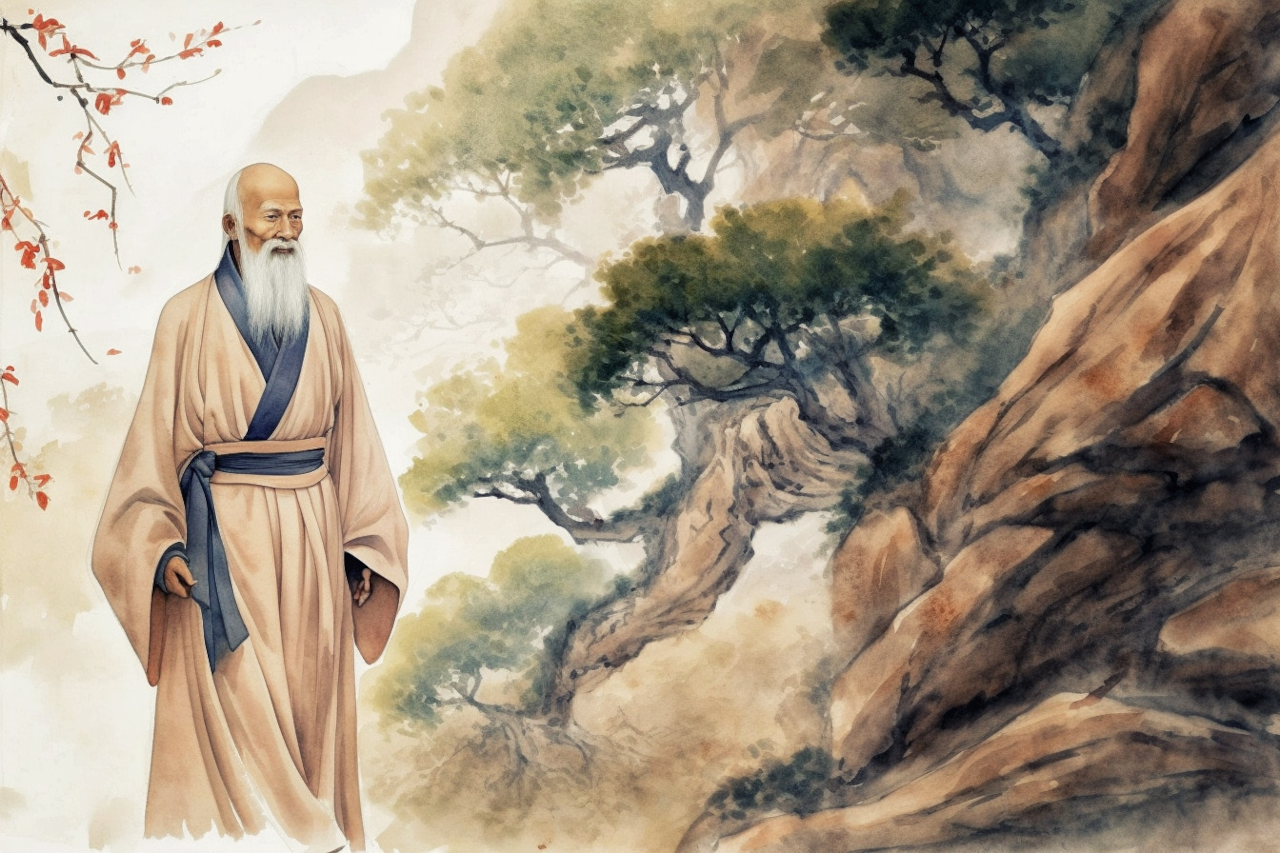
Lao Tzu (c. 6th century BCE) was an ancient Chinese philosopher and the legendary founder of Taoism. Murray Rothbard called him “the first libertarian intellectual” — a thinker who, twenty-five centuries before the Austrian economists, understood that government intervention is counterproductive and that spontaneous order emerges when individuals are left alone.
Life and Legend
Little is known with certainty about Lao Tzu’s life. The name itself is not a personal name but an honorific title meaning “Old Master.” Traditional accounts identify him as Li Er, a royal archivist for the Zhou court at Wangcheng (modern Luoyang) during China’s Spring and Autumn period.
According to legend, Lao Tzu met and impressed Confucius on at least one occasion. The two represent opposing poles of Chinese political philosophy: where Confucius advocated a well-ordered society governed by educated bureaucrats and elaborate rituals, Lao Tzu saw such interference as the source of social disorder rather than its cure.
The story goes that late in life, disillusioned with the corruption he witnessed, Lao Tzu departed civilization for the western wilderness. At the frontier, a guard recognised him and asked that he record his wisdom before leaving. The result was the Tao Te Ching — eighty-one short chapters composed, according to tradition, in a single session.
Modern scholarship questions many of these biographical details, suggesting they may be later inventions and that the Tao Te Ching itself was likely a collaboration of various writers over time. Yet the ideas attributed to Lao Tzu have profoundly shaped Chinese civilisation and, as libertarians have recognised, contain insights that resonate across millennia.
The Tao and Wu Wei
The Tao (or “Way”) is the central concept of Taoist philosophy — an underlying natural order of the universe that cannot be fully described in words but can be observed in nature and experienced through contemplation. As the Tao Te Ching opens:
“The Tao that can be told is not the eternal Tao. The name that can be named is not the eternal name.”
From this metaphysical foundation flows the political principle of wu wei — often translated as “non-action” or “non-interference.” This does not mean passivity or laziness, but rather refraining from action that goes against the natural grain of things. Applied to governance, wu wei counsels rulers to refrain from meddling in the lives of their subjects.
This is laissez-faire philosophy in its oldest and purest form. As Ken McCormick of the University of Northern Iowa observed, “laissez-faire is simply an extension of wu wei to government policy.”
The First Libertarian
In his essay “The Ancient Chinese Libertarian Tradition,” Murray Rothbard identified Lao Tzu as the first intellectual to articulate what we would now recognise as libertarian principles:
“For Lao-tzu the individual and his happiness was the key unit and goal of society. If social institutions hampered the individual’s flowering and his happiness, then those institutions should be reduced or abolished altogether.”
Lao Tzu viewed government — with its “laws and regulations more numerous than the hairs of an ox” — as “a vicious oppressor of the individual, and more to be feared than fierce tigers.”
The Tao Te Ching contains passages that could have been written by Bastiat or Hayek:
“The more artificial taboos and restrictions there are in the world, the more the people are impoverished… The more that laws and regulations are given prominence, the more thieves and robbers there will be.”
And on spontaneous order:
“I take no action yet the people transform themselves; I favor quiescence and the people right themselves; I take no action and the people enrich themselves.”
This understanding that harmony emerges not from central direction but from individuals pursuing their own paths — what Hayek would later call “spontaneous order” — places Lao Tzu firmly in the intellectual lineage that runs through the Scottish Enlightenment to the Austrian School.
Against War and Coercion
Lao Tzu was uncompromising in his opposition to war and the use of force:
“Whenever you advise a ruler in the way of Tao, counsel him not to use force to conquer the universe. For this would only cause resistance. Thorn bushes spring up wherever the army has passed. Lean years follow in the wake of a great war.”
And further:
“Now arms, however beautiful, are instruments of evil omen, hateful, it may be said, to all creatures. Therefore they who have the Tao do not like to employ them… he uses them only on the compulsion of necessity.”
This anti-war stance, grounded in both practical wisdom and moral principle, anticipates the non-interventionist tradition that runs through the classical liberals to modern libertarian foreign policy.
Retreat as Strategy
Rothbard noted something crucial about Lao Tzu’s approach: living under Oriental despotism with no historical example of successful libertarian social change, what strategy could he possibly advocate?
“It surely was unthinkable for Lao-tzu, with no available historical or contemporary example of libertarian social change, to set forth any optimistic strategy, let alone contemplate forming a mass movement to overthrow the State. And so Lao-tzu took the only strategic way out that seemed open to him, counseling the familiar Taoist path of withdrawal from society and the world, of retreat and inner contemplation.”
Rothbard suggested that this “retreatism” may have been born of strategic despair rather than principle — the only viable response to an all-encompassing state. The parallel to agorism and counter-economics is striking: when you cannot overthrow the state directly, you withdraw from it, build alternatives, and let it collapse under its own weight.
Influence and Legacy
The Tao Te Ching is one of the most translated texts in human history, and Taoist political philosophy has been recognised by thinkers across the political spectrum.
Peter Kropotkin, in his 1910 Encyclopædia Britannica article on anarchism, noted that Lao Tzu was among the earliest proponents of essentially anarchist concepts. Rudolf Rocker praised his “gentle wisdom” and understanding of the opposition between political power and cultural flourishing.
David Boaz of the Cato Institute included passages from the Tao Te Ching in his 1997 book The Libertarian Reader, noting that Lao Tzu advocated for rulers to “do nothing” because “without law or compulsion, men would dwell in harmony.”
More recently, anarchists such as John P. Clark and Ursula K. Le Guin have explored the conjunction between anarchism and Taoism, while libertarian scholars continue to find in these ancient texts a remarkably modern understanding of spontaneous order, the dangers of intervention, and the flourishing that comes when individuals are left free.
Key Work
Tao Te Ching (c. 6th century BCE) — Eighty-one short chapters on the Way, virtue, and governance. Multiple translations exist; those by Stephen Mitchell, Gia-Fu Feng, and D.C. Lau are widely respected. The text is available freely at the Online Library of Liberty.
Notable Quotations
“The more laws and restrictions there are, the poorer people become… The more rules and regulations, the more thieves and robbers.”
“Governing a great nation is like cooking a small fish — too much handling will spoil it.”
“The best rulers are those whose existence is barely known by the people.”
“Without law or compulsion, men would dwell in harmony.”
Influenced
- Zhuang Zhou (Zhuangzi)
- The entire Taoist tradition
- Chinese political philosophy
- Murray Rothbard (who called him “the first libertarian intellectual”)
Further Reading
- The Ancient Chinese Libertarian Tradition – Murray Rothbard, Mises Institute
- Liberty and Small Government in Tao Te Ching – Foundation for Economic Education
- Lao Tzu: The First Libertarian Intellectual – Acton Institute
- China’s Legacy: The Thoughts of Lao Tzu – Cato Institute

Leave A Comment